FacebookTwitterSign up for our newsletter!EspañolEnglish
Resources Free Lending Library
Habla Espanol?


New Jersey Adoption Resource Clearing House

The one-stop resource for those touched by adoption.

1-877-4ARCHNJ (1-877-427-2465)
Events In The News
Contact us
  • Home
  • About Us
  • Waiting Children
  • Conferences & Trainings
    • All Events
    • Conferences & Professional Training
    • Parent Training
    • E-Learning
  • Subsidy
  • Virtual Support
    • Chat Room
    • E-Learning
    • Online Support Groups
    • Podcasts
  • Research
  • Publications
    • Handbooks
      • NJ ARCH Top 15 Downloadable Handbooks
    • Newsletters

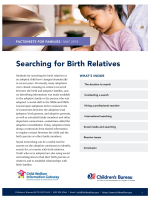
Searching for Birth Relatives

October 20, 2021 by NJ ARCH Editor

search

Searching for Birth Relatives
FACTSHEET FOR FAMILIES
May 2018
Methods for searching for birth relatives or an adopted child have changed dramatically in recent years. Previously, many adoptions were closed, meaning no contact occurred between the birth and adoptive families, and no identifying information was made available to the adoptive family or the person who was adopted. A social shift in the 1980s and 1990s toward open adoptions led to various levels of connection between the adoption triad (adoptee, birth parents, and adoptive parents), as well as extended family members and other important connections—sometimes called the adoption constellation. Today, adoption exists along a continuum from shared information to regular contact between the child and the birth parents or other family members.

Download Handbook
Searching for Birth Relatives

Filed Under: Handbooks

Prevention Resource Guide

October 6, 2021 by NJ ARCH Editor

guide+2011

This Resource Guide was developed by the Office
on Child Abuse and Neglect (OCAN) within the U.S.
Department of Health and Human Services’ Children’s
Bureau, Child Welfare Information Gateway, and the
FRIENDS National Center for Community-Based Child
Abuse Prevention. OCAN released its first Resource
Guide more than 15 years ago with the goal of raising
awareness about emerging child abuse prevention
concepts. It was created primarily to support communitybased
service providers who work to prevent child
maltreatment and promote family well-being. However,
over the years many others—including policymakers,
health-care providers, program administrators, teachers,
child care providers, parent leaders, mentors, and clergy—have found the resources useful.

Download Handbook
Prevention Resource Guide

Filed Under: Handbooks

Legal and Financial Differences Between Adoption and Kinship Legal Guardianship (KLG)

August 25, 2021 by NJ ARCH Editor

Legal and Financial Differences Between Adoption and Kinship Legal Guardianship (KLG)

The New Jersey Department of Children and Families (DCF) Division of Child Protection and Permanency (CP&P) strives to support all youth in care to achieve legal permanency
through reunification, adoption, or kinship legal guardianship (KLG). This document outlines legal and financial information regarding adoption and KLG. Additional information is
provided regarding policy, practice, and supports related to non-permanency CP&P case goals to provide a full picture of permanency options available

Download Handbook

Filed Under: Handbooks

Parenting Your Adopted Preschooler

July 15, 2021 by NJ ARCH Editor

adopted-preschool

Children ages 3 to 5 are limited in how much
they can understand about adoption. Like all
young children, adopted children are naturally
curious and may ask many questions. They are
also growing and changing rapidly. As their
abilities develop, so will their understanding
of their place in their families and
communities.

Download Handbook
Parenting Your Adopted Preschooler

Filed Under: Handbooks

Parenting Your Adopted Teenager

July 15, 2021 by NJ ARCH Editor

adopted-teen

The teenage years bridge the transition
from childhood to young adulthood. It is a
time of enormous change and development,
when youth forge an identity and embrace
new interests. Adoption adds complexity
to the normal development of teenagers,
regardless of whether they were adopted
as infants or when they were older. This
factsheet is designed to help adoptive parents
understand the needs and experiences of
their teen and use practical strategies to
foster healthy development. These strategies
include approaches that acknowledge
potential trauma and loss, support effective
communication, promote independence,
and address possible behavioral and mental
health concerns.

Download Handbook
Parenting Your Adopted Teenager

Filed Under: Handbooks

Parenting Your Adopted School-Age Child

July 15, 2021 by NJ ARCH Editor

adopted-school-age

School-age children—those between the ages of
6 and 12—learn critical skills and gain interests
that carry into adolescence and adulthood.
Adoption can add layers of complexity to a child’s
normal developmental tasks. You can support
your child by learning as much as possible about
the impact of adoption on your child’s emotional
growth and overall development.

Download Handbook
Parenting Your Adopted School-Age Child

Filed Under: Handbooks

Exploring the Pathways to Adoption

June 2, 2021 by NJ ARCH Editor

eploring-path

Adoption can be both exciting and overwhelming. The types of adoption may
seem confusing, and you may feel unprepared to parent a child who has experienced
separation and loss. As you explore the different pathways to adoption, you will
begin to understand how you can benefit from building and adjusting your knowledge,
attitude, and parenting techniques related to the emotional, developmental, social, and
physical needs of the child you adopt.

Exploring the Pathways to Adoption

Filed Under: Handbooks

Quick Reference Mental Health Guide

December 1, 2020 by NJ ARCH Editor

mental-health

Quick Reference Mental Health Guide

The COVID-19 pandemic continues to impact every aspect of our lives. This public health emergency has presented unprecedented challenges to our schools and communities. In June, the New Jersey Department of Education (NJDOE) released The Road Back: Restart and Recovery Plan providing necessary information and considerations for a return to in-person instruction to our school district leaders. Since the provision of those guidelines, districts have made difficult decisions regarding the safe reopening of their schools based upon local needs assessments, staffing capacities, current enrollment numbers, and the unique physical structures within each school. New Jersey students and educators returned to school utilizing operational models such as: hybrid learning, remote instruction, or full in-person instruction. While districts have approached the challenge of school reopening in a variety of ways, all school communities are facing the same fundamental reality that their students and staff have endured, and continue to endure, significant stress and trauma as a result of the ongoing pandemic.

Download Handbook
Quick Reference Mental Health Guide

Filed Under: Handbooks

Providing Respite Supporting People and Families Across the Lifespan

November 19, 2020 by NJ ARCH Editor

providing_respite

Providing Respite
Supporting People and Families Across the Lifespan
Defining Respite
Respite is a service that offers a short-term break for caregivers that regularly provide support to a child, adult, or senior family member with a disability or chronic health care need.
Respite may be planned, providing scheduled services to allow for intermittent breaks from caregiving, or may be available on an emergency basis in the case of unexpected life events that would negatively impact the individual receiving care. Emergencies could include a personal health crisis, job loss, or housing problem experienced by the caregiver.

Respite can be provided in a variety of settings, including:
In the family’s/individual’s home
In the respite provider’s home
Group homes or supervised apartments
Existing day care centers
Adult day programs
Camps

Download Handbook
Providing Respite Supporting People and Families Across the Lifespan

Filed Under: Handbooks

Getting Down to Basics,Tools to Support LGBTQ Youth in Care

October 27, 2020 by NJ ARCH Editor

getting-down

Lesbian, gay, bisexual, transgender and questioning (LGBTQ) young people are in
America’s child welfare and juvenile justice systems in disproportionate numbers.
Like all young people in care, they have the right to be safe and protected. All too
often, however, they are misunderstood and mistreated, leading to an increased risk
of negative outcomes. This tool kit offers practical tips and information to ensure that
LGBTQ young people in care receive the support and services they deserve. Developed
in partnership by the Child Welfare League of America (CWLA) and Lambda Legal, the
tool kit gives guidance on an array of issues affecting LGBTQ youth and the adults and
organizations who provide them with out-of-home care.

Download Handbook
Getting Down to Basics,Tools to Support LGBTQ Youth in Care

Filed Under: Handbooks

  • « Previous Page
  • 1
  • 2
  • 3
  • 4
  • 5
  • 6
  • …
  • 16
  • Next Page »
  • Contact us
  • Site Index
  • More Adoption Website Resources
  • Español
  • Satisfaction Survey
  • Needs Assessment
  • Terms
  • Privacy Notice
  • Disclaimer
This site is being provided under the auspices of Children's Aid and Family Services, Inc