

Kinship Adoption – Meeting the Unique Needs of a Growing Population

Every year, more and more children in foster care find permanent homes with relatives when they cannot return to live with their parents. Most children will find permanent homes through relative adoption, which continued to increase throughout the decade. In 2000, 21 percent of the children adopted from foster care were adopted by relatives. By 2007, relative adoptions from foster care accounted for 28 percent of the children exiting foster care.
This publication was a collaborative effort between ChildFocus and the North American Council on Adoptable Children
The GrandKin Guide
The national recognition that family connections are essential for children is applauded; though, it must come with assurances that children outside of foster care who have been removed from their parent’s home are afforded the equal protections and services received by those children who live in the foster care system.
The National Kinship Alliance for Children joins the voices of these extended families into one voice speaking out on behalf of these children. This GrandKin Guide has been written to help explain what extended families can expect when asked to care for children. Please share this with others you may know and join with us to bring our children out of the shadows and into the light. They, too, deserve our protection and our commitment.
Published by:
National Kinship Alliance for Children
P.O. Box 85
Ashland, VA 23005
Accreditation and Adoption Accredited Bodies: General Principle and Guide to Good Practice Guide 2
Published by
Family Law
A publishing imprint of Jordan Publishing Limited
21 St Thomas Street
Bristol BSI 6JS
For the Hague Conference on Private International Law
Permanent Bureau
6, Scheveningseweg
2517 KT The Hague
The Netherlands
Telephone +31(0)70 363 3303 fax +31(0)70 360 4867
e-mail secretariat@hcch.net website http://www.hcch.net
© Hague Conference on Private International Law 2012
The Implementation and Operation of the 1993 Hague Inter Country Adoption Convention Guide to Good Practice
Published by
Family Law
A publishing imprint of Jordan Publishing Limited
21 St Thomas Street
Bristol BSI 6JS
For the Hague Conference on Private International Law
Permanent Bureau
6, Scheveningseweg
2517 KT The Hague
The Netherlands
Telephone +31(0)70 363 3303 fax +31(0)70 360 4867
e-mail secretariat@hcch.net website http://www.hcch.net
© Hague Conference on Private International Law 2012
Families Considering Foster Care and Adoption

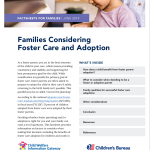
Helping Your Foster Child Transition to Your Adopted Child


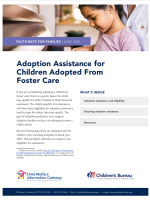
Adoption Assistance for Children Adopted From Foster Care

Survival Guide – For Parents
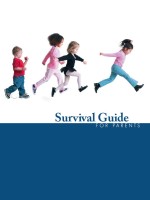
This book provides some of the knowledge needed to help you in your important role as a parent. Learning more about parenting and child development can make a world of difference for both you and your child. Increasing your understanding, together with your love for your child, can help you become a better parent – a very special person in your child’s world.
You expect a lot from your child … but your child’s age determines what you’ll get.
Parents somehow know that their child is not always going to behave perfectly. A child’s needs and actions change as he or she grows older, and all children develop at different rates. This is perfectly normal. However, knowing what to expect as your child goes through the different stages of life can help you a great deal. On the following pages you’ll find some behavior traits to expect as your child grows into an adult.
For Spanish version please click here.
Published by: Department of Children and Families
Helping Foster and Adoptive Families Cope With Trauma
The purpose of this guide is to support adoptive and foster families by strengthening the abilities of pediatricians to:
1) identify traumatized children,
2) educate families about toxic stress and the possible biological, behavioral, and social manifestations of early childhood trauma, and
3) empower families to respond to their child’s behavior in a manner that acknowledges past trauma but promotes the learning of new, more adaptive reactions to stress.
Published by:
© 2013 American Academy of Pediatrics and Dave Thomas Foundation for Adoption
- « Previous Page
- 1
- …
- 28
- 29
- 30
- 31
- 32
- 33
- Next Page »