
Survival Guide – For Parents
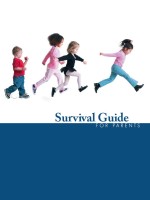
This book provides some of the knowledge needed to help you in your important role as a parent. Learning more about parenting and child development can make a world of difference for both you and your child. Increasing your understanding, together with your love for your child, can help you become a better parent – a very special person in your child’s world.
You expect a lot from your child … but your child’s age determines what you’ll get.
Parents somehow know that their child is not always going to behave perfectly. A child’s needs and actions change as he or she grows older, and all children develop at different rates. This is perfectly normal. However, knowing what to expect as your child goes through the different stages of life can help you a great deal. On the following pages you’ll find some behavior traits to expect as your child grows into an adult.
For Spanish version please click here.
Published by: Department of Children and Families
Helping Foster and Adoptive Families Cope With Trauma
The purpose of this guide is to support adoptive and foster families by strengthening the abilities of pediatricians to:
1) identify traumatized children,
2) educate families about toxic stress and the possible biological, behavioral, and social manifestations of early childhood trauma, and
3) empower families to respond to their child’s behavior in a manner that acknowledges past trauma but promotes the learning of new, more adaptive reactions to stress.
Published by:
© 2013 American Academy of Pediatrics and Dave Thomas Foundation for Adoption
Sibling Issues in Foster Care and Adoption
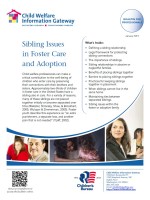
What’s inside:
• Defining a sibling relationship • Legal framework for protecting sibling connections • The importance of siblings • Sibling relationships in abusive or neglectful families • Benefits of placing siblings together • Barriers to placing siblings together • Practices for keeping siblings together in placement • When siblings cannot live in the same home • Maintaining ties between separated siblings • Sibling issues within the foster or adoptive family.
Published by:
Child Welfare Information Gateway
Children’s Bureau/ACYF 1250 Maryland Avenue,
SW Eighth Floor Washington, DC 20024 800.394.3366
Email: info@childwelfare.gov
https://www.childwelfare.gov
Adoption 101
This adoption awareness curriculum has been designed to help adoptive parent group leaders and others train child welfare, medical, legal, education, and mental health professionals, and other community members to be more responsive to the needs of adopted children and to work more effectively with their families.
North American Council on Adoptable Children
970 Raymond Avenue, Suite 106
St. Paul, MN 55114-1149
651-644-3036 FAX 651-644-9848
www.nacac.org • info@nacac.org
Diane Martin-Hushman, Parent Group Coordinator
hushman@nacac.org
Janet Jerve, Writer/Editor
janetjerve@nacac.org
State of New Jersey Department of Children and Families Division of Child Protection and Permanency Office of Adoption Operations Adoptive Parent Handbook
The Office of Adoption Operations is a licensed adoption agency within the State of New Jersey, Department of Children and Families, Division of Child Protection and Permanency (DCP&P). The Office of Adoption Operations is approved to provide adoption services to children in the public child welfare system, which includes placing children into adoptive homes as well as providing other adoption related services in New Jersey. Each year, the Office of Adoption Operations finalizes the adoptions of hundreds of children; the majority of whom are adopted out of the foster care system. Yet despite the success in ensuring permanency for many children, there are still children who are in need of an adoptive family. The decision to adopt a child and fully accept that child as your own is not often made with ease. There is a lot to consider before you make such a commitment. This handbook will provide you with important information regarding general characteristics of available children, who can adopt and a step by step guide regarding the adoption process.
New Jersey Department of Children and Families Office of Adolescent Services – Adolescent Resource Guide Addendum May 2012
Specific Programs and Information Regarding Permanency Programs, Life Skills Programs, Aftercare Programs, Wraparound Funds, Housing, Youth Advisory Boards (YABS), and DCP&P Policy/Forms.
This addendum is a supplement to the “CICIC Adolescent Resource Guide May 2012” and provides program and contact information for various adolescent services. In addition, this addendum will further detail wraparound funds (also known as Chafee funds), and Adolescent related DCP&P policy and forms.
Realistic Expectations – The First Year Home
Congratulations! Welcome to the journey of being an adoptive parent. As you get to know your child, you will realize what you don’t know! But not to worry, you aren’t alone. Take time to learn the skills to parent YOUR child. Connect with others who have similar experiences. Make time for yourself. The following articles were compiled as a great starting point for your education as a new adoptive parent.
Published by:
EMK Press • 16 Mt Bethel Road, #219 • Warren, NJ 07059 • 732-469-7544 732-469-7861 fax
www.emkpress.com
Beyond the Golden Rule

Whether you are the parent of a 3-year-old who is curious about why a friend’s skin is brown, the parent of a 9-year-old who has been called a slur because of his religion, or the parent of a 15-year-old who snubs those outside of her social clique at school, this book is designed to help you teach your children to honor the differences in themselves and in others — and to reject prejudice and intolerance. Three age-specific sections feature everyday parents sharing personal stories about the challenges and rewards of raising children in today’s diverse world. Psychologists, educators and parenting experts offer practical, age-appropriate advice to help you integrate lessons of respect and tolerance in day-to-day activities. And a final section offers guidance for reflecting upon your own biases, and how those biases affect your parenting.
We welcome your thoughts on these issues.
Email us at parents@tolerance.org,
or write to us at Beyond the Golden Rule, c/o Teaching Tolerance, 400 Washington Ave., Montgomery, AL 36104.

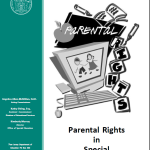
Parental Rights in Special Education
New Jersey Administrative Code for special education (N.J.A.C. 6A:14) and the federal Individuals with Disabilities
Education Act of 2004 (IDEA 2004) are laws that ensure children with disabilities a free, appropriate public education in the least restrictive environment. An important part of these laws provides parents with the right to participate in their children’s education.
You and representatives of your school district are team members who are responsible for developing an appropriate educational program for your child. This document will describe the state and federal laws affecting the provision of special education to help you understand your rights in the special education process. With this knowledge, you will be prepared to take an active role in your child’s education.
This document has been developed for you by the Department of Education, Office of Special Education, in an effort to provide the most comprehensive and up-to-date information. The document is periodically revised to reflect changes in the law, provide additional information that would be of use to you, and to provide the information in a more clear and concise manner.
This document was last revised in May 2023.